Ever wondered why many website visitors don’t buy anything? In India’s fast-growing digital market, catching someone’s eye is just the start. Businesses need a strategic path to lead people to buy.
This process, known as a sales funnel, turns curious visitors into loyal customers. It’s like a blueprint for understanding how people buy things. By following this path, companies can find out where they lose people and fix those spots.
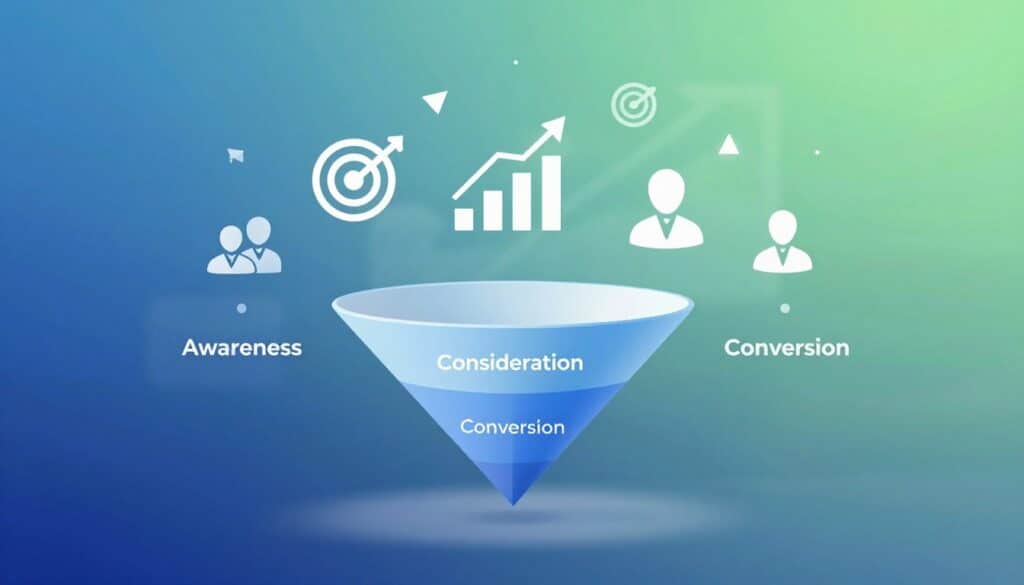
To grow, marketers must know the key stages of the buyer’s journey. This article looks at seven important steps to boost revenue and keep customers coming back. By using these methods, businesses can do better and reach their goals.
Key Takeaways
- Understand the modern digital buyer journey.
- Identify the seven core conversion stages.
- Enhance user engagement through targeted strategies.
- Optimize lead generation for better quality.
- Maximize overall business revenue and growth.
- Refine marketing efficiency using data-driven steps.
Understanding the Sales Funnel in Today’s Digital Landscape
The sales funnel is key in today’s digital world. It’s more complex now. Businesses need to grasp its details and optimize it for better results.
The Anatomy of a High-Performing Sales Funnel
A top sales funnel is not just a simple path from start to sale. It’s a complex system with many touchpoints and insights. Key components include knowing the customer’s journey, using personalized content, and smooth transitions.
Efficient funnel strategy means finding and fixing bottlenecks. Use technology for automation and keep an eye on performance to make smart choices.
| Component | Description | Impact on Funnel |
| Awareness Stage | Initial customer contact through various marketing channels | Sets the tone for the customer journey |
| Consideration Stage | Nurturing leads with targeted content and engagement | Builds trust and establishes brand credibility |
| Decision Stage | Finalizing the sale through strategic persuasion | Directly affects conversion rates |
Why Traditional Funnel Models Fail in Modern Markets
Old sales funnel models don’t cut it in today’s fast, digital world. Primary reasons include their inability to keep up with changing consumer habits and lack of integration with new marketing tools.
Today’s buyers want personalized and quick experiences. Businesses must be quick and flexible in their sales strategies.
The Indian Business Context and Unique Challenges
The Indian market has its own set of hurdles for businesses. Key challenges include varied consumer tastes, fast-changing trends, and the need for local marketing.
To thrive, businesses must tailor their sales funnel strategies for India. Use local insights and data to guide your decisions.
Case Study Introduction: TechVision Solutions’ Revenue Transformation
The story of TechVision Solutions’ revenue transformation shows the power of strategic sales funnel optimization. This case study explores how a leading Indian tech company overcame stagnant conversions and revenue leakage.
Company Background and Market Position
TechVision Solutions is a key player in the Indian tech sector, focusing on software development and IT services. It has a strong presence in India and is growing globally. Yet, despite its good market standing, TechVision struggled to turn leads into sales.
The Problem: Stagnant Conversions and Revenue Leakage
The company faced a big problem with low conversion rates, leading to lost revenue. Despite spending a lot on marketing, the results were not good. The sales team was overwhelmed with unqualified leads, making things harder.
Initial Funnel Metrics and Baseline Performance
To grasp the issue, TechVision looked at its sales funnel metrics. They found a low conversion rate of 2.5% and an average sales cycle of 120 days. The data showed big drop-offs at the consideration and decision stages.
| Funnel Stage | Conversion Rate | Average Time Spent |
| Awareness | 80% | 15 days |
| Consideration | 20% | 45 days |
| Decision | 2.5% | 60 days |
The Strategic Decision to Overhaul the Funnel Strategy
Seeing the need for change, TechVision’s leaders decided to change its sales funnel strategy. They aimed to better funnel analytics, improve lead quality, and make the sales process smoother. This marked the start of a big change for the company.
Step 1: Advanced Customer Journey Mapping for Funnel Optimization
The first step to improve a sales funnel is advanced customer journey mapping. This process uncovers key insights into how customers behave. It shows how customers interact with a brand at different stages and touchpoints.
Conducting Deep-Dive Customer Research and Analysis
Deep-dive customer research collects and analyzes data from many sources. It looks at customer needs, preferences, and pain points. This includes surveys, social media listening, customer interviews, and feedback analysis. It gives a holistic view of customers’ journeys.
For example, TechVision Solutions did deep research by looking at customer support tickets, social media, and sales team insights. They found out where customers were struggling. This helped them adjust their sales funnel.
Identifying Critical Touchpoints Across the Sales Pipeline
Finding key touchpoints is vital for a better sales funnel. These are moments when customers interact with the brand, like visiting the website or contacting support. By mapping these, businesses can streamline the customer journey, making it smoother and more personal.
- Website visits and engagement metrics
- Social media interactions and feedback
- Email opens and click-through rates
- Customer support inquiries and resolution rates
Creating Data-Driven Buyer Personas
Creating buyer personas uses customer research insights. It makes detailed profiles of ideal customers. These profiles help businesses understand their audience’s needs and behaviors, guiding marketing strategies.
TechVision Solutions made buyer personas from their research. They included demographic info, job roles, pain points, and buying behaviors. This helped them tailor marketing messages and boost engagement.
TechVision’s Journey Mapping Process and Discoveries
TechVision analyzed customer interactions across touchpoints. They found customers were leaving at the consideration stage. This was due to a lack of relevant content and unclear value propositions.
With this knowledge, they refined their content strategy. This improved the customer experience.
By using advanced customer journey mapping, TechVision found and fixed key pain points in their sales funnel. This led to better conversion rates and customer satisfaction.
Step 2: Building a Multi-Channel Lead Generation Engine
A multi-channel lead generation engine is key for any successful sales funnel. It helps businesses attract and engage their target audience well. This step is about creating a strategy that captures leads across different touchpoints, building a strong pipeline of qualified leads.
Designing High-Converting Lead Capture Mechanisms
To boost lead generation, businesses need to create effective lead capture mechanisms. This means making offers like eBooks, webinars, and free trials that appeal to the audience and get them to share their contact info. These mechanisms should be easy to use, look good, and work well.
For example, TechVision Solutions improved their lead capture by using interactive content like quizzes and assessments. This move greatly increased user engagement and lead generation.
Content Strategy for Top-of-Funnel Awareness
A solid content strategy is vital for awareness at the top of the funnel. It drives traffic and generates leads. Creating high-quality, relevant, and informative content that meets the audience’s needs is key. TechVision Solutions made blog posts, infographics, and videos that drew in customers and showed the company’s expertise.
Social Media and Paid Advertising Integration
Adding social media and paid ads to the lead generation engine boosts reach and visibility. TechVision Solutions used targeted social media campaigns and paid ads on Google and LinkedIn to get more people to their lead capture pages. This approach helped their message reach more people, leading to a big jump in lead generation.
Lead Generation Results from TechVision’s Implementation
TechVision’s multi-channel lead generation engine brought great results. The company saw a big increase in lead volume and better lead quality. By always checking and improving their strategies, TechVision kept a steady flow of qualified leads. This helped their revenue grow and the business expand.
Step 3: Implementing Marketing Automation for Scale
To boost conversions, a key step is to use marketing automation for growth. This method automates routine tasks and uses data to make the sales funnel more efficient.
In India, picking the right automation tool is essential. The tool must fit the company’s needs, growth goals, and budget.
Selecting Automation Platforms for Indian Businesses
Indian businesses should look at several things when choosing marketing automation platforms. Important factors include how easy it is to set up, how customizable it is, and the quality of customer support. Market leaders like Marketo, Pardot, and HubSpot offer different features for various business sizes and needs.
| Platform | Key Features | Scalability |
| Marketo | Email marketing, lead scoring, CRM integration | Highly scalable for large enterprises |
| Pardot | Lead generation, lead nurturing, ROI reporting | Scalable, specially for B2B businesses |
| HubSpot | Inbound marketing, sales enablement, CRM | Scalable for businesses of all sizes |
Building Automated Nurturing Sequences
Automated sequences are key in guiding leads through the sales funnel. By creating content and workflows based on triggers, businesses can send the right info at the right time.
TechVision Solutions created a detailed nurturing sequence. It included educational content, product info, and special offers. This built trust and kept leads engaged.
Trigger-Based Communication Workflows
Trigger-based workflows help businesses respond quickly to customer actions. By setting up triggers, companies can send timely and relevant messages.
How Automation Reduced TechVision’s Sales Cycle by 40%
With marketing automation, TechVision Solutions cut their sales cycle by 40%. Automation let the company focus on important tasks while managing lead nurturing and follow-ups well.
Marketing automation improved TechVision’s sales funnel and customer experience. It led to better conversion rates and revenue growth.
Step 4: Strategic Conversion Optimization at Every Stage
Strategic conversion optimization is key to unlocking a sales funnel’s full power. By focusing on conversion optimization at every stage, businesses can greatly improve their sales and revenue.
Awareness Stage: Capturing Attention and Building Trust
At the awareness stage, the goal is to grab the audience’s attention and build trust. This can be done with high-quality content that speaks to the target audience and engaging visuals that catch the eye.
Some effective strategies include:
- Creating informative blog posts and guides
- Using social media to reach more people
- Leveraging influencer marketing to gain credibility
Consideration Stage: Nurturing and Demonstrating Value
In the consideration stage, it’s important to nurture leads and show the value of your product or service. This means providing detailed product information, customer testimonials, and comparative analysis with competitors.
Key tactics include:
- Email nurturing campaigns to keep leads engaged
- Webinars and demos to showcase product benefits
- Case studies highlighting success stories
Decision Stage: Removing Friction and Closing Deals
At the decision stage, the focus is on removing any obstacles that might stop a lead from converting. This can be done through streamlined checkout processes, clear call-to-actions, and transparent pricing.
Landing Page Optimization Techniques
Optimizing landing pages is critical for conversion. Techniques include:
- A/B testing different page elements
- Ensuring mobile responsiveness
- Using compelling headlines and CTAs
Call-to-Action Best Practices
Effective CTAs are key to driving conversions. Best practices include:
- Using action-oriented language
- Placing CTAs prominently on the page
- Ensuring CTAs are visually appealing
Here’s a comparison of different CTA strategies:
| CTA Strategy | Conversion Rate |
| Action-Oriented Language | 12% |
| Prominent Placement | 15% |
| Visually Appealing Design | 18% |
TechVision’s A/B Testing Results and Conversion Lifts
TechVision implemented various A/B testing strategies, resulting in significant conversion lifts. For instance, optimizing their landing page copy and CTAs led to a 25% increase in conversions.
By applying strategic conversion optimization techniques at every stage of the sales funnel, businesses can achieve substantial improvements in their conversion rates and overall revenue.
Step 5: Refining the Sales Pipeline Through Lead Scoring
Refining the sales pipeline is key to boosting conversions and revenue. The fifth step is to use advanced lead scoring to improve the pipeline. This helps businesses focus on the best leads for their sales team.
Lead scoring ranks prospects based on their value to the company. It assigns scores to leads based on their actions and traits. This way, businesses can spot the most promising leads.
Developing a Predictive Lead Scoring Model
To create a predictive lead scoring model, analyze past data and look for patterns. This model uses factors like demographics, engagement, and behavior to guess if a lead will convert.
Key components of a predictive lead scoring model include:
- Demographic data: firmographic information, job title, industry, etc.
- Engagement metrics: email opens, link clicks, content downloads, etc.
- Behavioral data: website interactions, social media engagement, etc.
This approach helps businesses build a scoring system that accurately predicts lead quality.
Aligning Sales and Marketing Teams Around Qualified Leads
Effective lead scoring needs a strong bond between sales and marketing. By agreeing on what makes a lead qualified, both teams can work together. This ensures the sales team gets leads that are more likely to convert.
Alignment strategies include:
- Regular communication and feedback loops
- Shared definitions of lead qualification criteria
- Collaborative development of lead scoring models
This teamwork is vital for a smooth sales pipeline.
Prioritization Frameworks for Maximum Efficiency
Prioritization frameworks help sales teams focus on the most valuable leads. By sorting leads by score, businesses can use their resources wisely. This ensures high-priority leads get the attention they need.
Impact on TechVision’s Sales Team Productivity
Lead scoring greatly boosted TechVision’s sales team productivity. By focusing on quality leads, the team could close deals faster. This led to a significant jump in productivity.
Key outcomes included:
- Increased conversion rates due to better lead quality
- Improved sales team efficiency through prioritized lead management
- Enhanced alignment between sales and marketing teams
Step 6: Personalization and Segmentation for Higher Engagement
The sixth step to boost conversions is using personalization and segmentation. This makes the customer experience more tailored and engaging. By knowing and meeting the needs of different groups, businesses can improve engagement and conversion rates.
Personalization is key in today’s market. It uses data and analytics for targeted marketing. This makes campaigns speak to individual customers or groups.
Behavioral Segmentation Strategies That Work
Behavioral segmentation groups customers by their actions, like purchases and browsing. This lets businesses tailor messages and offers to each group’s needs.
For example, customers who left items in their cart can get emails. These remind them of their purchases and offer deals to finish buying.
Dynamic Content Customization Across Channels
Dynamic content customization uses data to show relevant content across channels. This includes email, social media, and websites.
It offers personalized product suggestions, special deals, and content that meets the customer’s needs and interests.
Account-Based Marketing for Enterprise Segments
Account-Based Marketing (ABM) targets specific accounts and decision-makers. It uses personalized content and messaging.
ABM works well for big companies with long sales cycles and many stakeholders.
Personalization’s 63% Impact on TechVision’s Conversion Rates
TechVision Solutions used personalization, including segmentation and dynamic content. This led to a 63% increase in conversion rates. It shows how personalization can greatly impact business results.
By focusing on personalization and segmentation, TechVision made its customer experience more engaging. This led to more conversions and revenue growth.
Step 7: Establishing Continuous Funnel Analytics and Optimization
Creating a strong system for ongoing funnel analytics and optimization is key in today’s digital world. This step helps businesses keep an eye on their sales funnel’s performance. It lets them make smart choices to improve it.
Continuous funnel analytics is very important. It helps businesses find and fix problems, use new chances, and increase their conversion rates. With funnel analytics, companies can understand their customers better. This leads to a better customer experience.
Essential Funnel Analytics Metrics to Track Daily
To keep track and improve the sales funnel, businesses need to watch key metrics every day. These are:
- Conversion rates at each stage of the funnel
- Drop-off rates between stages
- Average time spent in each stage
- Lead velocity
- Customer acquisition cost (CAC)
By watching these metrics closely, businesses can spot and fix problems fast. They can then make specific changes to get better results.
Building a Data-Driven Optimization Framework
A framework based on data is key for ongoing improvement. It includes:
- Setting clear goals and KPIs
- Gathering and analyzing data from different places
- Finding trends and patterns
- Testing ideas and making changes
- Seeing how changes affect things and keeping improving

Following this framework helps businesses make sure their efforts to improve are based on data. This way, they focus on getting real results.
Tools for Real-Time Funnel Performance Monitoring
There are many tools to help businesses watch their funnel’s performance as it happens. These include:
- Google Analytics
- Marketing automation platforms like Marketo or Pardot
- CRM systems with analytics
- Special tools for funnel analytics
Using these tools, businesses can get instant insights into their funnel’s performance. They can then make quick changes.
TechVision’s Iterative Improvement Methodology
TechVision’s method for getting better involved checking their funnel metrics often. They found areas to improve and made specific changes. They kept doing this to make their funnel better and boost their conversion rates.
By using a similar method, businesses can keep their sales funnel in top shape. This ensures it keeps bringing in conversions over time.
Navigating Implementation Challenges and Roadblocks
The path to improving a sales funnel is filled with obstacles. These can slow down progress and affect performance. Businesses aiming to boost conversions must tackle these challenges head-on.
Addressing Budget Constraints in Resource-Limited Environments
Budget limits are a big challenge for businesses. Not enough money can limit what you can do with your sales funnel. To get around this, focus on the most important steps first.
Cost-effective strategies include using what you already have, reusing content, and finding cheap marketing tools. Being smart with your spending can lead to big wins without spending a lot.
Overcoming Technology Integration Complexity
Getting different technologies to work together is hard. Look for tools that are easy to integrate and grow with your business.
API-driven solutions and middlemen make data sharing easier. Working with tech experts can also help you get past these hurdles.
Managing Organizational Change and Team Buy-In
Changing your sales funnel strategy means changing how your team works. Getting everyone on board is key to success.
Good change management means explaining why the change is good, training well, and supporting your team. A team that works together can overcome any obstacle.
Solutions TechVision Applied to Common Obstacles
TechVision faced the same challenges but found ways to beat them. They mixed different methods to find what worked best for them.
By using data and keeping customers first, TechVision made their sales funnel better. They improved their conversion rates and overcame their obstacles.
Comprehensive Results Analysis and ROI Documentation
TechVision’s sales funnel overhaul led to big wins. They saw a jump in conversion rates and revenue. This section will dive into the details of their success, showing how their smart choices made a difference.
Quarter-by-Quarter Conversion Rate Improvements
TechVision’s new sales funnel strategy paid off. They saw a 25% increase in the first quarter. Then, a 15% rise in the next quarter.
Their success came from advanced customer journey mapping and strategic conversion optimization. These steps helped guide customers smoothly through the sales process.
Revenue Growth and Customer Acquisition Cost Reduction
The new sales funnel strategy boosted revenue. TechVision’s revenue jumped by 30% in six months.
- They cut customer acquisition costs by 20% by improving lead generation and nurturing.
- They also saw a better return on investment (ROI) thanks to smart marketing and a more productive sales team.
Impact on Customer Lifetime Value and Retention
The new strategy also raised customer lifetime value (CLV) and retention. TechVision’s CLV grew by 18% by making the customer experience more personal and engaging.
They also saw a 12% increase in customer retention rates. This move strengthened their market position.
Six-Month Performance Summary and Key Metrics
Here’s a look at TechVision’s six-month performance after the change.
| Metric | Pre-Implementation | Post-Implementation (6 months) |
| Lead-to-Opportunity Conversion | 20% | 35% |
| Opportunity-to-Customer Conversion | 15% | 25% |
| Overall Revenue | $1 million | $1.3 million |
Lead-to-Opportunity Conversion Increase
The lead-to-opportunity conversion rate jumped from 20% to 35% in six months. This was thanks to better lead nurturing and targeted marketing.
Opportunity-to-Customer Conversion Enhancement
The opportunity-to-customer conversion rate also improved, from 15% to 25%. This shows a more efficient sales process and better teamwork between sales and marketing.
Overall Revenue Impact
The results of these improvements were clear. TechVision’s revenue rose by 30%, proving the success of their new sales funnel strategy.
Strategic Takeaways and Implementation Roadmap
As we wrap up our deep dive into TechVision Solutions’ sales funnel makeover, it’s key to highlight the main takeaways. These insights can help other companies boost their conversions by optimizing their funnel strategy.
The journey of TechVision Solutions teaches us a lot about creating a top-notch sales funnel. By learning from these lessons, businesses can improve their own funnel optimization efforts.

Critical Success Factors from the Case Study
Several key factors led to TechVision Solutions’ success in transforming their funnel. These include:
- Advanced Customer Journey Mapping: Knowing the customer’s path was vital for spotting problems and chances for betterment.
- Multi-Channel Lead Generation: Using different channels helped grab leads from various points.
- Marketing Automation: Automation was key in guiding leads and boosting efficiency.
Lessons Learned and Best Practices
The case study shows us several best practices for funnel transformations. It stresses the role of funnel analytics in making informed decisions and the need for ongoing improvement.
Companies should also focus on making things personal and segmented. This can improve customer interaction and boost conversion rates.
Recommended Timeline for Funnel Transformation
The time it takes to transform a funnel varies by company size and complexity. A step-by-step approach is usually best. This includes:
- Initial assessment and planning phase (Weeks 1-4)
- Putting new strategies and tech into action (Weeks 5-12)
- Watching and tweaking phase (After Week 12)
Next Steps for Organizations Starting Their Journey
For companies starting their funnel makeover, start with a detailed look at your current funnel and customer journey. This will show you where to improve and guide your funnel strategy development.
By following the strategic takeaways and roadmap we’ve outlined, businesses can prepare for success in their own funnel transformation projects.
📊 Track Like a Pro Marketer: Stop guessing where your visitors are dropping off in your funnel. Track every single click, behavior, and conversion for absolutely free using the Official Google Analytics Platform.
📧 Close Sales on Auto-Pilot: A sales funnel without emails is like a leaking bucket. Learn how to nurture your captured leads and turn them into loyal paying customers automatically with our master guide on Email Marketing Strategies.
Conclusion
A well-optimized sales funnel is key for businesses to boost conversions and grow revenue. TechVision Solutions’ case study shows how a strategic overhaul can greatly improve conversion rates and customer acquisition.
Advanced customer journey mapping, a multi-channel lead generation engine, and marketing automation are essential. These tools help create a high-performing sales funnel. It’s important to keep optimizing and refining the sales funnel to stay ahead in the digital world.
Learning from TechVision’s journey offers valuable insights for other businesses. By using data and focusing on personalization and segmentation, companies can see significant revenue growth. This also improves customer lifetime value.
A well-designed sales funnel is vital for a business’s success. It helps guide prospects through the buyer’s journey, leading to long-term growth.
FAQ
How does advanced customer journey mapping contribute to funnel optimization?
Advanced customer journey mapping gives a detailed look at how prospects interact with a brand. It helps identify key touchpoints and areas where things might slow down. Companies like TechVision Solutions can then fine-tune their funnel strategy to match how buyers really behave.This approach makes sure conversion optimization efforts are focused where they matter most. It helps improve the sales pipeline significantly.
Why is marketing automation considered essential for scaling a sales funnel?
A: Marketing automation lets businesses talk to many leads at once in a personal way. It uses automated workflows and sequences to keep engagement going. For TechVision Solutions, using automation cut their sales cycle by 40%.
What role does lead generation play in the overall funnel strategy?
A: Lead generation is the first step in the sales funnel. It uses LinkedIn Ads, Google Search, and valuable content to bring in good prospects. The goal is to focus on quality over quantity, filling the sales pipeline with the right people.
How can businesses use funnel analytics to prevent revenue leakage?
A: Funnel analytics show where leads are falling off. By tracking conversion rates and how fast leads move through the funnel, managers can spot weak spots. This lets them make small changes to keep the funnel strong and profits high.
What is the impact of personalization and behavioral segmentation on conversion optimization?
A: Personalization and behavioral segmentation make marketing more specific and relevant. By tailoring content to users’ actions and interests, engagement goes up. For example, TechVision Solutions saw a 63% increase in conversions by matching their messages to specific groups and behaviors.
How does a predictive lead scoring model improve sales team productivity?
A predictive lead scoring model ranks prospects based on their chances of closing. This helps sales and marketing teams focus on the best leads. It saves time by avoiding unqualified leads and boosts conversion chances.
What are the primary challenges when implementing a modern funnel strategy?
Common hurdles include complex technology, tight budgets, and needing to change how the organization works. To tackle these, a clear funnel optimization plan is key. TechVision Solutions overcame these by starting small and showing the value of their efforts.
