Did you know over 80% of brands worldwide use partnerships to boost sales? This huge industry is full of chances, but many newbies in India feel lost. They think they need a lot of money to start.
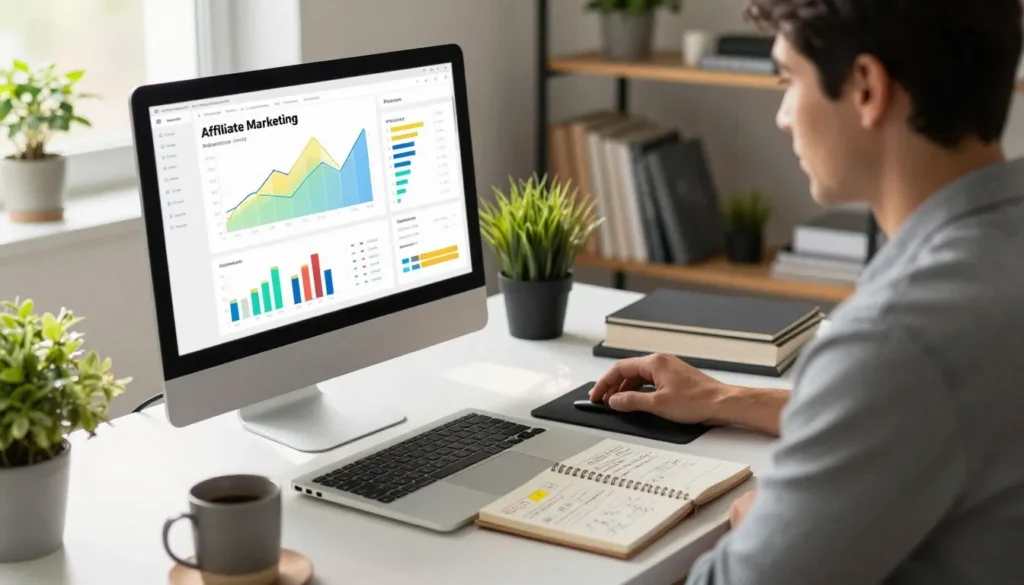
I used to think the same until I found affiliate marketing software solutions that cost nothing. These tools completely changed how I work and increased my online earnings. They make managing campaigns from home super easy.
Now, I want to share my top free picks that helped me grow. You can use these to track your success and reach more customers without spending a Rupee. Let’s see how these smart choices can boost your earnings today.
Key Takeaways
- Start your journey without spending money on software.
- Use efficient resources to manage your links and promotions.
- Boost your monthly income with cost-effective methods.
- These options are perfect for creators living in India.
- Streamline your daily tasks to save more time.
- Scale your digital business without any financial risk.
Why I Rely on Free Affiliate Marketing Tools
Free affiliate marketing tools have changed the game for me. They help me manage my campaigns well without extra costs. This way, I can focus on making my strategies better.
I choose free tools because they save money, which is great for new marketers. Using the best affiliate tools for free lets me spend more on other important parts of my campaigns.
Free tools also let me test and improve my marketing before spending money. This method has helped me find the best tools and strategies for my campaigns.
Here’s a look at some popular free affiliate marketing tools:
| Tool | Primary Function | Cost |
| Google Analytics | Tracking Affiliate Performance | Free |
| Canva | Creating Affiliate Graphics | Free (with optional paid upgrades) |
| Pretty Links | Managing Affiliate URLs | Free (with optional paid upgrades) |
By using these affiliate marketing resources, I can make my workflow better. This improves my campaign’s performance and helps me get more conversions.
💡 Fast-Track Tip: Tools only work if you know where to use them. Before setting up your automation, make sure your website is structurally ready by following our guide on Affiliate Link Placement: 7 Best Secret Spots.
In summary, relying on free affiliate marketing tools has been key to my success. They help me manage my campaigns well and give me insights to improve my strategies.
Essential Criteria for Choosing the Best Affiliate Marketing Tools
Choosing the best affiliate marketing tools can be tough without the right criteria. There are many options, making it easy to feel overwhelmed. I’ve found important factors that make a tool valuable for success in affiliate marketing.
The first thing to look for is ease of use. A tool that’s hard to use can waste a lot of time. For example, managing many affiliate programs is easier with a tool that’s easy to use. Pat Flynn from Smart Passive Income said,
“The right tools can simplify your workflow and amplify your results.”
Another important factor is integration capabilities. A tool should work well with other platforms and software you use. This makes your workflow smoother and reduces errors. For instance, if you use email marketing, your affiliate link management software should work well with it.
Scalability is also key. As your affiliate marketing grows, your tools should grow with you. Look for tools with flexible pricing and that can handle more traffic or data without slowing down.
Also, customer support is very important. Good customer support can fix problems fast, keeping your campaigns running smoothly. Choose tools with reliable support, like live chat, email, and phone.
Lastly, check the tool’s reputation and reviews. Reading what others say can give you a good idea of a tool’s strengths and weaknesses. Websites like Trustpilot and G2 Crowd are great for finding honest reviews.
In summary, picking the right affiliate marketing tools requires careful thought. Focus on ease of use, integration, scalability, customer support, and reputation. This way, you can make choices that will help your affiliate marketing succeed.
Google Analytics for Tracking Affiliate Performance
Google Analytics is key for tracking your affiliate marketing success. It helps you understand your audience better. This way, you can improve your marketing strategies.
Understanding User Behavior on Your Affiliate Site
Studying user behavior shows you what content works best. It also points out areas for improvement. Knowing how users move through your site helps you make it better.
To get this insight, you need to look at Google Analytics data. Check out page views, bounce rates, and how long users stay on your site.
Setting Up Conversion Tracking for Affiliate Links
Tracking conversions is vital for seeing how well your affiliate marketing does. Google Analytics lets you track conversions for your affiliate links. This way, you know which campaigns are the most effective.
📊 Real-Time Data: Professional marketers never guess; they track. According to the Official Google Analytics Resource, accurate data tracking is the difference between a failing blog and a six-figure affiliate business.
To start tracking conversions, do the following:
- Create a goal in Google Analytics for each affiliate link.
- Use UTM parameters to track each affiliate link’s performance.
- Look at the conversion data to find out which campaigns work best.
| Campaign | UTM Parameters | Conversions |
| Campaign 1 | utm_source=affiliate&utm_medium=link&utm_campaign=campaign1 | 100 |
| Campaign 2 | utm_source=affiliate&utm_medium=link&utm_campaign=campaign2 | 50 |

By using these methods, you can track and improve your affiliate marketing with Google Analytics.
🚀 Strategy Alert: Managing tools is easy, but choosing a niche that actually pays high commissions is the real secret. To scale your earnings, check out our masterclass on High Ticket Affiliate Marketing: 5 Best Strategies.
Canva for Creating High-Converting Affiliate Graphics
Canva has been a game-changer for me in affiliate marketing. It helps me make stunning visuals that grab people’s attention. Visual content is key to success in any affiliate marketing platform. Canva makes it easy to create professional-looking graphics.
Canva offers a wide range of templates for different social media and affiliate marketing needs. This lets me customize my graphics for each platform. It ensures I get the most engagement possible.
Designing Professional Banners for Affiliate Offers
Creating banners that convert is an art. Canva gives me the tools to make banners that attract and engage my audience. Here are some key features I use:
- Customizable templates for various banner sizes
- A vast library of fonts, images, and graphics
- User-friendly drag-and-drop editor
With these features, I can make banners that promote affiliate offers well. They help drive traffic to my website.
Optimizing Visuals for Social Media Promotion
Social media is great for promoting affiliate links. Canva helps me make my visuals pop on different platforms. I follow these best practices:
- Using platform-specific dimensions for images and videos
- Incorporating brand-consistent colors and fonts
- Adding compelling calls-to-action (CTAs) to my visuals
Optimizing my visuals with Canva boosts my social media engagement. It helps drive more conversions through my affiliate marketing.
Leveraging Canva for affiliate graphics is a simple yet effective strategy. It can greatly improve your affiliate marketing campaigns.
Pretty Links for Managing and Cloaking Affiliate URLs
In my journey as an affiliate marketer, I’ve found Pretty Links to be a game-changer. It makes managing affiliate URLs easy. Pretty Links helps me cloak my affiliate URLs, making them look better and increasing click-through rates.
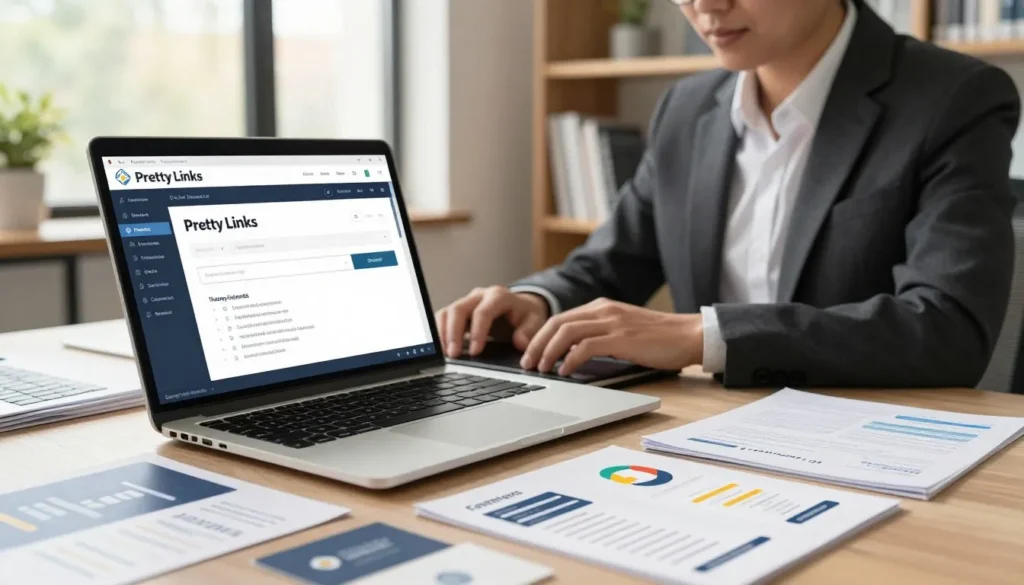
With Pretty Links, I can create clean, branded links. These links are more appealing to my audience. This improves the user experience and makes my affiliate marketing look more professional.
The Importance of Clean Affiliate Link Structures
Clean affiliate link structures are key for several reasons. They make links more trustworthy and easier to remember. Instead of long, complicated URLs, I can offer concise, branded links that my audience will like.
Clean links also improve the overall user experience, making it more likely for visitors to click on them. Plus, Pretty Links lets me categorize and manage my affiliate links well. This makes it easy to track and analyze their performance.
Tracking Click-Through Rates with Link Management
Tracking click-through rates (CTR) is vital for understanding my affiliate marketing success. Pretty Links gives me detailed insights into link performance. This helps me see which links are working well and which need improvement.
By analyzing CTR data, I can improve my marketing tactics. I focus on the strategies that give the best results. This data-driven approach is key to maximizing my affiliate marketing ROI.
In conclusion, Pretty Links is a must-have tool for me. It simplifies link management and boosts my ability to track and optimize affiliate links. This leads to better campaign performance.
Mailchimp for Building Your Affiliate Email List
Mailchimp is a key tool for affiliate marketers to boost their email marketing. Building an email list is vital for success. It lets you connect with your audience and share relevant offers.
Mailchimp is known for being easy to use and packed with features. It helps you create, automate, and analyze email campaigns. This makes it perfect for affiliate marketers wanting to grow their audience and increase sales.
Automating Affiliate Email Sequences
Mailchimp’s automation feature is a game-changer. It lets you send out emails automatically. This way, your audience gets the right content at the right time, without you having to do it manually.
To start automating your emails in Mailchimp, follow these steps:
- Create a new campaign and choose the “Automated” option.
- Pick the type of automation you need, like a welcome email or an abandoned cart sequence.
- Use Mailchimp’s editor to design your emails. Make sure they look good on all devices.
- Set up triggers and actions to make your emails more personal based on subscriber behavior.
As
“Email marketing is not just about sending emails; it’s about creating a conversation with your audience.”
points out, automating your emails can make your conversations more engaging and personal.
Segmenting Your Audience for Better Conversion
Segmenting your email list is key to better conversions. By dividing your audience based on their interests, behaviors, or demographics, you can tailor your content. This way, you meet their needs better.
Mailchimp lets you segment your audience in many ways. You can use subscriber data, email behavior, and purchase history. This helps you create campaigns that really speak to your audience.
| Segmentation Criteria | Description | Benefits |
| Subscriber Data | Segment based on information subscribers provide, such as location or interests. | More personalized content |
| Email Behavior | Segment based on how subscribers interact with your emails, such as opens or clicks. | Improved engagement |
| Purchase History | Segment based on past purchases or interactions with your products. | Targeted promotions |

Using Mailchimp’s segmentation features can greatly improve your affiliate email marketing. It leads to higher conversion rates and a more engaged audience.
Ubersuggest for Keyword Research and SEO Strategy
To succeed in affiliate marketing, having a solid SEO strategy is key. Ubersuggest is a powerful tool for this. It helps find relevant keywords, analyze competitor backlinks, and improve your content for better search engine rankings.
I’ve used Ubersuggest a lot and it’s really effective. It finds low-competition keywords and analyzes competitor backlinks. This is vital for a successful affiliate marketing strategy that boosts traffic and conversions.
Finding Low-Competition Keywords for Affiliate Content
Finding keywords that aren’t too competitive is a big challenge in affiliate marketing. Ubersuggest helps by giving you a list of keyword suggestions. It shows search volume, competition level, and cost-per-click (CPC).
For example, if you’re promoting fitness products, Ubersuggest can suggest keywords like “best yoga mats for beginners” or “home workout routines for weight loss.” These keywords have less competition and can attract relevant traffic with quality content.
| Keyword | Search Volume | Competition Level | CPC |
| best yoga mats for beginners | 2,900 | Low | $0.50 |
| home workout routines for weight loss | 1,300 | Medium | $0.75 |
| yoga for weight loss | 820 | Low | $0.40 |
Analyzing Competitor Backlinks for Growth
Understanding your competitors’ backlink profiles is key for growing your own. Ubersuggest has a backlink analysis tool. It shows your competitors’ top backlinks, anchor text distribution, and more.
Rand Fishkin, founder of Moz, said, “Links are a top ranking factor. Knowing your link profile is vital for SEO success.” By analyzing competitors’ backlinks, you can spot gaps in your own profile and get a strategy to get better backlinks.
“The key to success is to focus our conscious mind on things we desire not things we fear.”
– Brian Tracy
Ubersuggest lets you analyze competitors’ backlinks and find opportunities for high-quality backlinks. This can boost your website’s authority, drive more traffic, and improve your search engine rankings.

By using Ubersuggest for keyword research and backlink analysis, you can create a strong SEO strategy. This will drive real results for your affiliate marketing business.
Integrating These Tools into Your Daily Workflow
Adding these affiliate marketing tools to my daily routine has really helped me work better. To use these affiliate marketing resources well, you need to fit them into your daily life smoothly.
I start my day by looking at my Google Analytics. This lets me see how people are using my site and how my affiliate links are doing. It helps me know where to put my focus.
“The key is not to prioritize what’s on your schedule, but to schedule your priorities.” This saying helps me manage my affiliate marketing tasks. By focusing on what’s important, I can do better work.
Then, I set aside time for making content and promoting it. I use Canva to make professional banners and improve my social media posts. For example, I spend a few hours on Wednesday mornings making new graphics and posts.

Managing affiliate URLs with Pretty Links is also a regular task for me. It keeps my affiliate links clean and lets me track how well they’re doing.
To make your work easier, think about automating tasks. For example, using Mailchimp for automated emails can save time and keep your audience engaged.
Lastly, use Ubersuggest for keyword research and SEO. It helps me find new chances and stay competitive.
By adding these tools to your daily routine, you can work more efficiently. This can lead to better affiliate marketing strategies and more money.
Common Mistakes to Avoid When Using Free Software
Using free affiliate marketing tools can be very helpful. But, it’s important to avoid some common mistakes. This way, you can get the most out of these tools.
One big mistake is not setting up affiliate tracking software right. Tools like Google Analytics are great for tracking your affiliate links. But, if you don’t set up conversion tracking correctly, you’ll get wrong data. This makes it hard to see how well your campaigns are doing.
Another mistake is not making your affiliate graphics fit for different places. For example, Canva is great for making banners and visuals. But, if you don’t adjust them for each social media platform, they might not work well. Remember, the right image can make a big difference.
“The right tool is only as good as the person using it.” This quote shows how important it is to know and use free software tools well.
To avoid these mistakes, take time to learn each tool. For instance, Pretty Links is great for managing affiliate URLs. But, you need to set it up right to track clicks well.

Knowing these mistakes and how to avoid them can help you use free affiliate marketing tools better. This includes checking your affiliate marketing platform analytics often. This way, you can make smart choices and improve your strategies.
In short, while free software is very useful in affiliate marketing, it’s not something you can just forget about. You need to keep learning and improving to succeed.
⚖️ Legal Safety: Automated tools can make you fast, but transparency makes you trusted. Always disclose your affiliate relationships clearly as per the FTC Endorsement Guides to keep your account safe from bans.
Conclusion
Looking back, using the right tools has been key to my success in affiliate marketing. Tools like Google Analytics, Canva, Pretty Links, Mailchimp, and Ubersuggest have helped me a lot. They’ve made my work easier and helped me make better choices.
I suggest you check out these free tools and use them every day. Doing this will help you improve your affiliate marketing and reach your money goals.
With these tools and a good plan, you can do great things in affiliate marketing. You’ll learn more about your audience and make smart choices. This will help you succeed and earn more.
FAQ
Why should I start with free affiliate marketing tools instead of paid versions?
Starting with free tools is smart because it saves money. Tools like Ubersuggest and Canva are very valuable. They offer great features that are as good as paid options.Using these tools, I can make more money and then invest it back into my business. This way, I get the best tools for keyword research and design without spending a lot.
How does Google Analytics function as affiliate tracking software?
Google Analytics is my go-to for tracking affiliate links. It lets me see how users behave in real-time. I set up custom events and goals to track which content works best.This tool is key for knowing which content brings in money. It helps me understand what my audience likes and what drives sales.
Can I use Mailchimp for affiliate program management?
Mailchimp is great for managing affiliate programs. I use it to segment my audience. This way, I can send personalized affiliate offers.By targeting my audience, I keep my emails relevant and avoid spam. This approach helps me keep my audience engaged and earning commissions.
Is Pretty Links really necessary for my affiliate marketing platform?
Pretty Links is essential for me. It connects my content to vendors smoothly. It makes tracking affiliate links easy and hides ugly URLs.This tool builds trust with my readers. It helps me get more clicks and boosts my earnings.
What makes a specific tool qualify as top affiliate marketing software?
When choosing top affiliate marketing software, I look for reliability and ease of use. The tool must solve a problem, like Ubersuggest helps with content ideas.The best tools save time and give me the data I need. They help me improve my campaigns and earn more.
How do I choose the right affiliate marketing resources for my niche?
I start with the basics: tracking, design, and communication. Tools like Canva and Mailchimp are essential. They’re used daily and offer a clear return on investment.I focus on tools that grow my audience and increase my earnings. The right tools make a big difference in my success.
